WSLH PT Blog
Bringing you clinical lab features, news, and updates via the WSLH PT Blog! If you are interested in receiving an email digest of news along with curated staff picks from around the internet, sign up for WSLH PT’s monthly newsletter, The MedLab Retriever.
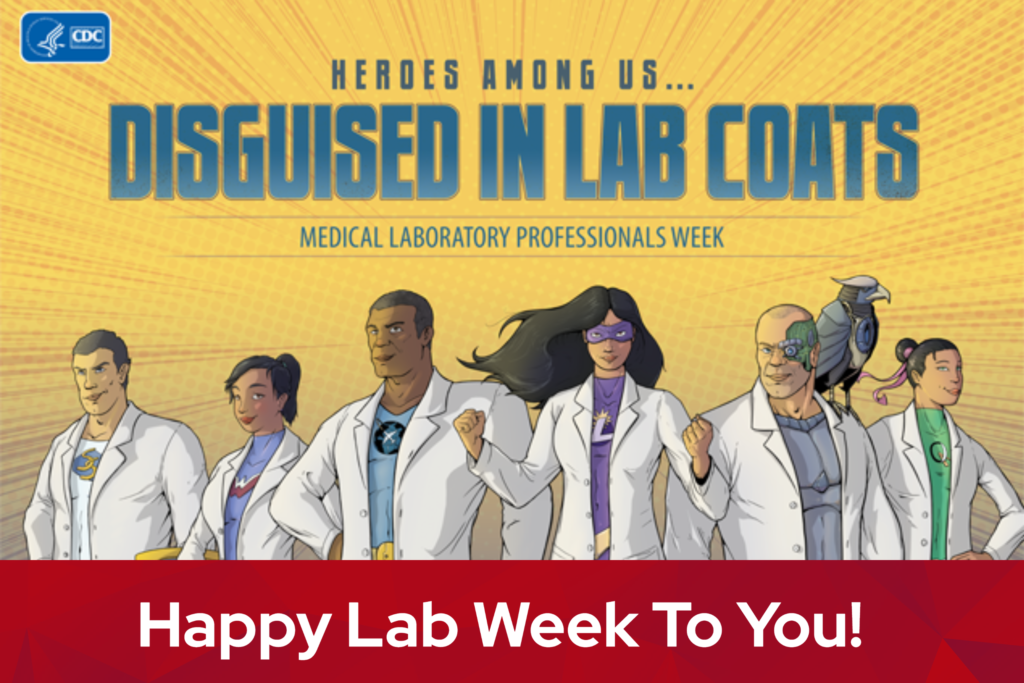
Happy Medical Laboratory Professionals Week!
Medical Laboratory Professionals Week is a time when we increase public awareness of our profession, highlighting our contributions to healthcare. We also celebrate our staff by sharing our appreciation – laboratory professionals get results! This year, Lab Week is on April 23-29. Professional associations, like ASCP and ASCLS encourage us to honor and celebrate ourselves as well as our coworkers. There are lots of great ideas and resources for how to celebrate your coworkers. How do you celebrate yourself during Lab Week? In this article, WSLH Proficiency Testing shares a few ideas and resources that can help us cultivate an appreciation for ourselves (and each other) as medical laboratory professionals. Recognizing your unique contributions and sharing your appreciation with others, in turn, can deepen the public’s awareness of our important role in providing accurate, timely testing results.
Recognizing our value
We know our value in healthcare. There are statistics and other important information that show the public our impact. What is often even more impactful is sharing why and how we value what we do. When we take time to self-reflect, we strengthen our appreciation for ourselves. If we are able to better express our appreciation, others will appreciate us too.
Reflecting on our growth
You can start this process of self-reflection by thinking about how much you have grown as a laboratory professional. Your education and training have prepared you to perform complex tasks safely. You may look at trainings and courses and think about how they have helped you produce accurate, reliable, and timely results. Reflecting on your commitment to professional development can help you appreciate your contributions. With increased appreciation, you are more willing to share appreciation with others. Sharing your appreciation with the public invites them to recognize and celebrate what you do as a lab professional.
Go ahead, treat yourself
Thinking about the ways you have grown, or how you continue to challenge yourself is a great way to start brainstorming how to celebrate yourself during Lab Week. For example, maybe you helped develop a mentoring program to support new employees and strengthen teamwork. During Lab Week, you could play your favorite cooperative board game with your coworkers to celebrate teamwork. You know yourself best in what gives you a sense of accomplishment and satisfaction. Creating your own personal recognition activity can also support ways to recognize and celebrate coworkers and employees more meaningfully.
The power of employee recognition
When you encourage yourself and others to also celebrate in meaningful ways, you foster authentic connections and help others see their value as team members. In a recent survey on employee recognition conducted by Great Place To Work, 37% of respondents said that more personal recognition would encourage them to produce better work results more often. Neuroscience certainly backs up this statement, with research that illustrates how both predictable and randomized reward systems support happier, more motivated work environments. Below, we provide one example of how you can celebrate yourself in a way that helps everyone see the bigger picture, to see the contributions of laboratory professionals to quality patient care.
Expressing gratitude, expressing value
Practicing gratitude can be a great way to illustrate your unique contributions to quality patient care. For each day during Lab Week, try sharing 1-3 things that you are grateful for as a laboratory professional. Don’t forget, you can include your team members on this list! Write them down on paper, on a whiteboard, or post them on social media, for example. Expressing gratitude is one way you can share your role, experiences, and expertise. Sharing deepens awareness and increases our appreciation of our contributions. This simple practice can generate new perspectives, as you recognize how you personally value the profession. Who knows, you may have a positive experience that will compel your workplace to continue this practice with you, year-round. You may be surprised how simple expressions of thankfulness can inspire others to do their best in the workplace.
Conclusion
Recognition and celebration are powerful motivators that help us feel connected and engaged with our work. How you celebrate Lab Week this year can be a great way to set the tone for how you support yourself, year-round. The more recognition and appreciation we give each other, the more meaningful our celebrations will be. Sharing why you celebrate Lab Week also gives others a closer look at the importance of the medical laboratory profession. WSLH Proficiency Testing is grateful for your dedication and significant contributions to the health and safety of our communities. Happy Medical Laboratory Professionals Week from our team at WSLH PT to yours.
Learn more about Lab Week and download resources on the following websites:
American Association for Clinical Pathology (ASCP): Lab Week (ascp.org)
American Society for Clinical Laboratory Science (ASCLS): Medical Laboratory Professionals Week – ASCLS
American Medical Technologists (AMT): Celebrate Medical Laboratory Professionals Week
WSLH PT Blog
Bringing you clinical lab features, news, and updates via the WSLH PT Blog! If you are interested in receiving an email digest of news along with curated staff picks from around the internet, sign up for WSLH PT’s monthly newsletter, The MedLab Retriever.
Wastewater Surveillance at WSLH and Our Impact on Public Health
Everyone poops — a universal fact that has long provided information on disease spread in communities. For two and half years, the Wisconsin State Laboratory of Hygiene (WSLH) has tracked SARS-CoV-2 and its variants in Wisconsin’s sewage. Our laboratory’s findings in wastewater have provided public health officials in Wisconsin with a more detailed picture of the virus that other forms of testing cannot easily capture. This nuanced data can lead to a timelier public health response to outbreaks in the future.
WSLH Proficiency Testing is a part of the WSLH, a national public, environmental, and occupational health laboratory. We keep you up-to-date on WSLH’s advancements in public health, to lift up our shared work in improving patient care and the overall health of our communities.
During the outbreak of the COVID-19 pandemic, the partnership formed between the Wastewater Surveillance Team and communities across Wisconsin resulted in the creation of a robust wastewater surveillance system. The participation of wastewater treatment plants and municipal workers in the program is crucial for sample collection and data analysis to track SARS-CoV-2 variants. The WSLH team says keeping wastewater treatment plants (WWTPs) enrolled in the program may be the biggest challenge going forward.
“Their [WWTP] participation needs to be better recognized and acknowledged because they are essential to the program,” said Adelaide Roguet, Water Microbiology Scientist at WSLH. “No samples, no data.” As they strengthen their collaborations in Wisconsin, the Wastewater Surveillance Team is working with other surveillance networks in the United States to coordinate a nationwide effort.
The WSLH Wastewater Surveillance Team is expanding its efforts, helping other public health laboratories develop their own wastewater surveillance systems. Last year, the Association of Public Health Laboratories (APHL) released a guide to help public health labs build wastewater surveillance programs. WSLH senior scientist Martin Shafter contributed a significant wealth of information to this guide. He says that the experience of the Wastewater Surveillance Team informed his contributions to this guide. Expanding wastewater surveillance efforts across the United States can help direct public health efforts to lessen the spread of variants.
We are excited about the progress we have made in developing a wastewater surveillance network in Wisconsin,” says Adelaide Roguet, Water Microbiology Scientist at WSLH. “We are particularly excited about following seasonal flu and RSV this winter and adding gastrointestinal and antibiotic-resistance pathogens in the near future.”
Since the beginning of the COVID-19 pandemic, our scientists have understood the importance of wastewater surveillance as an epidemiological tool. One of the unique applications of wastewater surveillance is the ability to find those who carry a completely new virus before it spreads in the community. Nature magazine outlined such findings from the lab’s collaborative effort, detailing the search for a cryptic SARS-CoV-2 variant in Wisconsin. Supporting the expansion of these efforts will be crucial to creating a coordinated testing effort to stop the spread of pandemic outbreaks and test the efficacy of vaccines in the future.
WSLH Proficiency Testing hopes the benefits of the WSLH Wastewater Surveillance program to Wisconsin communities will inspire more laboratories nationwide to join the wastewater surveillance journey. WSLH Proficiency Testing is just one division among a mighty group of public health champions at the WSLH laboratory. We keep you up-to-date on public health advancements at WSLH, shining a bright spot on our shared work to better the health and well-being of our communities.
WSLH PT Blog
Bringing you clinical lab features, news, and updates via the WSLH PT Blog! If you are interested in receiving an email digest of news along with curated staff picks from around the internet, sign up for WSLH PT’s monthly newsletter, The MedLab Retriever.
Imagine that you are at a conference, full of clinical laboratory professionals.
Ready to start networking?
When we network, we meet people for more information or professional contacts. However, networking is not easy, even with many years of career experience. In this article, we have provided you a list of resources to help you make better use of your next networking event. Which networking tips for laboratory professionals do you find the most helpful? Sometimes it is helpful to start by asking ourselves a few questions.
Do you want to network to:
- recruit more laboratory staff?
- create new, innovative scientific partnerships?
- solve testing problems in your laboratory?
Reading about the benefits and strategies of networking can help us identify goals and create action steps to accomplish them. So, grab a stack of your business cards, and let’s get started.
Networking Tips for Laboratory Professionals: A Different Perspective
Sign up to watch 3 free webinars on how to network, and why it is important for clinical laboratory professionals. Learn conversational strategies for networking in person and on LinkedIn. Please click this link to register for the first webinar in this series: https://www.clinicallab.com/trends/career-development/networking-a-different-perspective-26684.
ASCP Members Can Reap the Benefits of Local Chapters
In this article, medical technologists talk about the benefits of going to local chapter meetings. Please click the link to read this article: https://www.ascp.org/content/news-archive/news-detail/2022/07/13/ascp-members-can-reap-the-benefits-of-local-chapters#
Networking on LinkedIn: Why You Should and How to Do It
You do not need to be very active on social media to find LinkedIn useful for your own purposes. LinkedIn has grown a lot as a professional social network since its start in 2003. With over 800 million users worldwide, LinkedIn offers endless networking and learning opportunities. This article discusses the many uses of LinkedIn to help you reach your goals. Please click this link to read the article: https://www.linkedin.com/pulse/networking-linkedin-why-you-should-how-do-tzufit-herling
Strategies for Laboratory Professionals to Drive Laboratory Stewardship
This article discusses developing formalized networks of organizational support for laboratories. Read about creating laboratory stewardship groups to improve patient care across health systems. Please click this link to read the article: https://www.sciencedirect.com/science/article/pii/S2352551721000494
Conclusion
Whether you are new or have been a professional for decades, there are many resources to help us network. In this article, we have provided a small number of networking tips for laboratory professionals as a launchpad to help you plan. The resources that we have shared included some of the following shared ideas about networking:
- Knowledge-sharing:
We share (and receive) news, advice, and guidance in professional circles and other networking spaces. Sometimes we learn from others and ourselves in surprising or unexpected ways! - Career Advancement:
In networking spaces, we meet other people who can help us grow in our careers, or find new job opportunities. Being curious and asking for help are two actions we can take to help us create new opportunities for career advancement. - Innovative Solutions:
We often gain new perspectives in conversation with others. Our creative intellect improves when we have strong professional and social circles. Increased creative cognition helps us solve problems or improve practices in our workspaces.
Reading about positive experiences and outcomes from networking motivates us to do more. Are you planning to attend a conference or another networking event soon? View our calendar to see where WSLH Proficiency Testing will be this spring. We look forward to seeing you at one of these conferences. In the meantime, we invite you to connect with us and our staff members on LinkedIn.
WSLH PT Blog
Bringing you clinical lab features, news, and updates via the WSLH PT Blog! If you are interested in receiving an email digest of news along with curated staff picks from around the internet, sign up for WSLH PT’s monthly newsletter, The MedLab Retriever.
With continuing education programs, clinical laboratorians have opportunities for professional improvement year-round
New Year, New You – This social media-inspired saying marks the New Year as a time of renewed resolve to improve ourselves in some way. This feeling of renewed resolve encourages us to seek ways to continually improve ourselves in our work. As clinical laboratorians, pursuing continuing education opportunities is a key part of not only maintaining but improving the quality of our work. It is for this very reason that attaining CE credits is required for clinical laboratory scientists today to maintain certification. In light of this ongoing need for CE programs, laboratory managers may offer their staff free course offerings as part of their job benefits package to support the professional development of their staff. With this added job perk, lab managers can measure competency more closely. WSLH Proficiency Testing offers a large variety of online training and competency programs at low cost in partnership with Medical Training Solutions (MTS) at the University of Washington. These program offerings are most often used as a tool to measure staff competency, on a twice-per-year basis. In this article, we provide a question-and-answer (Q & A) section for more information about our partnership with MTS and how it benefits laboratories.
What is MTS?
Medical Training Solutions, or MTS, is a program offered by WSLH PT, which originates from the University of Washington. MTS develops and publishes online training and competency courses on a wide range of clinical topics. These topics are appropriate for a variety of educational contexts, including initial training. Educational content includes images, which also may serve as a tool for remedial training. MTS also provides management tools, such as document tracking, email notifications, and kit-specific, point-of-care trainings.
How does MTS work?
Laboratories choose programs from the list of program offerings, and may enroll with their proficiency testing order. Our best enrollment option includes all training and competency programs for 1 year for up to 30 users. The competency programs include 2 different sets of content/per year to meet competency requirements. Our point-of-care training and competency options are popular as well.
You determine the number of users on the account and then enroll. Your account set-up is part of an automated process that allows you to quickly assign one staff member or many staff members to certain selections. Then, staff receives an automated notification by email with the appropriate links to access the materials. The administrator then monitors progress and results. Account administrators can also upload their own tracking documents. CE credits are earned at the completion of the programs.
What are the different types of education provided?
Training programs include items such as Safety, Specimen Collection, Specimen Processing, and all the subspecialties including molecular diagnostics. Competency courses include 10-question multiple-choice tests related to the subject. Microscopy procedures are also available for both training and competency programs. A lecture library series is also available which includes a monthly topic as well as access to archived lectures. Over 50 CE credit hours are available upon completion of these programs, combined.
What are some advantages of using MTS?
The MTS online training and competency coursework is provided as an additional offering to participants. MTS develops programs in response to emergent and trending topics. Some advantages are:
- The programs are also low-cost, especially when multiple staff participates.
- You may order your MTS products alongside your proficiency testing products to make it easier for purchasing.
- You are able to choose programs to meet your needs instead of being unsure of what you will receive.
- Real-time reporting is also available in the competency assessment offerings, which means your score is available to view right away.
Helping you assure your laboratory’s professional training and competency goals is important to us. If you are interested in learning more, you may review our MTS programs on our website, as well as watch a short video tour. A demo account may be requested if you want to see first-hand some of the program content prior to enrolling. Please contact WSLH PT with any additional questions.
If you are interested in reading more related articles about Continuing Education and professional development resources, check out other articles on our blog at wslhpt.org/blog, or sign up to receive this content and more via our monthly e-digest, The Med Lab Retriever.
WSLH Proficiency Testing hopes that you have a great start to 2023 and that you and your staff have everything that you need to support your laboratory’s goals. Thank you for all that you have accomplished in 2022, and we look forward to providing excellent service to you and your laboratory this year.
WSLH PT Blog
Bringing you clinical lab features, news, and updates via the WSLH PT Blog! If you are interested in receiving an email digest of news along with curated staff picks from around the internet, sign up for WSLH PT’s monthly newsletter, The MedLab Retriever.
What policies and processes are in place in your laboratory? In preparation for a laboratory inspection, this is the question you have at the forefront of your mind. We also have this question at the forefront of our minds too, but for different intentions and outcomes. A proficiency testing provider may experience a routine audit, as well as annual reviews of accepted analytes conducted by an accreditation agency, such as those conducted by the College of American Pathologists (CAP). The purpose of a proficiency testing audit is to provide you with the best experience when it comes to participating in our proficiency testing services. These processes of review and approval assure that you can use our proficiency testing services alongside your accreditation agency. In this article, we share with you an overview of the auditing process, and how it impacts you, the clinical laboratory.

An Inside Look at a PT provider
The Clinical Laboratory Improvement Amendments (CLIA) of 1988 are today’s standards for compliance and accreditation. Following the passage of CLIA ’88, laboratories that are reporting clinical results are mandated by law to attain CLIA certification with CMS. All CLIA-certified labs are also required to perform proficiency testing on regulated analytes with any CMS-approved proficiency testing provider. Accreditation agencies are approved to act on behalf of CMS as an accrediting body. In response, the College of American Pathologists, developed a routine process as an accreditation agency to accept PT providers. This process assures that any CAP-accredited laboratory may enroll with any PT provider that meets CAP’s requirements regarding the acceptability of materials, scoring processes, and transmission of data. Today, when CAP-accredited laboratories are choosing a PT provider, they are determining if the PT provider and the analytes they need are accepted by CAP.
In order for WSLH Proficiency Testing to be a CAP-accepted PT provider, CAP representatives audit WSLH PT services every 3 years. During the auditing process, WSLH PT shares data with CAP from laboratories that choose CAP for accreditation. The following are the kinds of questions WSLH PT answers in a CAP audit:
- Are laboratories getting the information they need?
- Is the information presented in such a way that is easy to understand?
- Does the PT provider maintain consistency in how their technical coordinators evaluate data?
CAP representatives conclude the audit by visiting our office at the Wisconsin State Lab of Hygiene in Madison, Wisconsin. This day-long visit includes a shared review and discussion of key findings in data. Review and discussion of data offer insights into issues that laboratories may be encountering throughout the proficiency testing process.
All regulated analytes that CAP-accredited laboratories select from a PT provider must pass through an annual approval process to be CAP-accepted. If an analyte is CAP-accepted, then CAP will accept the score transmission of a CAP-accredited laboratory from the PT provider. Every year PT providers have the opportunity to apply for CAP acceptance for an analyte by filling out a form and submitting it by July for potential approval the following year. At the very minimum, PT providers must have 20 data points for three events in a row for quantitative analytes. For qualitative analytes, PT providers need 10 data points for three events in a row. Beyond the review of grading data, there are other criteria that CAP uses in determining the acceptability of regulated analytes. The other information that CAP requests from PT providers include, but are not limited to:
- Instrumentation, methods used, and number of participants
- Participant summary data for events
- Number of challenges and shipments per year
- Supporting documentation for analyte specifications and event data
- A statement that all material vendors comply with specified product manufacturing standards
Not all regulated analytes offered by PT providers are approved by CAP; so, laboratories that want to use their materials to meet CAP’s accreditation requirements must first check with the appropriate PT providers. If you review WSLH Proficiency Testing’s clinical product catalog, you will see that any analytes that are not accepted by CAP are noted with an asterisk (*). When CAP-accredited laboratories approach WSLH PT to enroll, they know which analytes will meet their regulations with the CAP Laboratory Accreditation Program.
Routine audits and annual analyte acceptance conducted by CAP assure that we can serve and provide options to CAP-accredited laboratories. Aligning our services and processes with the CAP Laboratory Accreditation Program not only benefits CAP-accredited laboratories but all clinical laboratories that enroll with WSLH Proficiency Testing. Whether or not CAP is your accreditation agency, the findings we review in a CAP audit help us assure that our materials, from general instructions to evaluation reports and policies, are accurate, clear, and concise for all laboratories. This inside look into our partnership with CAP provides some insight into how we pursue collaboration, usability, and continual development to lay a solid foundation for laboratory improvement.
WSLH PT Blog
Bringing you clinical lab features, news, and updates via the WSLH PT Blog! If you are interested in receiving an email digest of news along with curated staff picks from around the internet, sign up for WSLH PT’s monthly newsletter, The MedLab Retriever.
Watch our webinar for an opportunity to receive a free CE credit upon completion
So, you’ve failed a proficiency test–now what? While it may be difficult to move to a course of action in the moment, preparing for this scenario ahead of time can give clinical laboratory professionals the tools we need to do so, with more ease. WSLH Proficiency Testing is offering you access to a new ASCLS P.A.C.E. certified webinar, developed in partnership with the Wisconsin Clinical Laboratory Network (WCLN).
This webinar aims to help participants know how to follow-up, prepare, and prevent common scenarios in clinical proficiency testing. While this webinar was originally created for the WCLN, WSLH Proficiency Testing is now offering you the same educational opportunity. We hope that this webinar will provide you with useful information to share with your staff. You may access and progress through the webinar at your own pace. Upon completion, you will have an opportunity to earn a free CE credit.
At the end of this webinar, participants will be able to:
- Identify clinical proficiency testing best practice
- Increase knowledge of labs’ experiences with conducting proficiency testing
- Explain what a laboratory must do when they have a proficiency testing failure
Participants will be able to take away key insights from WSLH Proficiency Testing’s technical coordinators serving on the webinar panel: Ann Hennings, MLS (ASCP) and Rhonda Stauske, MLS (ASCP). This P.A.C.E. certified webinar is graded at an intermediate level, meaning the educational content serves mostly as a refresher course with some basic knowledge of proficiency testing required for a participant to successfully complete the program objectives.
Oh no! I’ve failed a proficiency test–Now what? webinar
Please click the following link to access the free, archived P.A.C.E certified webinar
for an opportunity to earn a C.E. credit upon completion: https://slhstream2.ad.slh.wisc.edu/Mediasite/Play/72ee607528264590a210cf03037e54241d
Note:
You will need to login (or register for free, if you are not a member) on the ASCLS CE Organizer webpage in order to claim your free CE credit. Once logged in, please click the Claim Credit tab in the top navigation bar. Then click on the ASCLS State and Regional tab to locate ASLCS-Wisconsin. You will find the webinar listed by date for November 2nd, 2022. Check the box to the right to select this credit. You will be prompted to enter in the information needed from there.
Over the past few months, our technical coordinators at WSLH Proficiency Testing collaborated with other experts at the Wisconsin State Lab of Hygiene (WSLH) to support an educational training opportunity, as part of a series of educational webinars offered by and for a network of clinical labs in Wisconsin. This network of clinical labs is known as the Wisconsin Clinical Laboratory Network (WCLN), which is coordinated by Erin Bowles, MLS (ASCP), who we featured in an article last year about her unique role as a medical laboratory professional in providing outreach and support to clinical labs throughout the State of Wisconsin. We also featured the history of the WCLN, which offers outreach and resources to support emergency preparedness, disease surveillance, laboratory diagnostics, training and education, and communications. WSLH Proficiency Testing collaborates with other entities at WSLH to add value to the labs we serve. From our most recent collaboration with the WCLN, we hope you find this webinar to be a helpful resource for your staff.
As part of WSLH Proficiency Testing’s mission to improve laboratory quality for all, providing educational opportunities to promote career competency and achieve leadership development goals are very important to us in our unique role as a PT provider that is backed by a national public health lab and a Big Ten University. To learn more about other resources we offer labs, please view our resources page on our website at: wslhpt.org/resources. If you are interested in online training and competency courses to offer to your entire staff as a benefit for their professional development, please keep in mind WSLH PT’s comprehensive offerings of online training and competency MLS courses.
If you have any questions about the content we cover in this free PACE certified webinar, please do not hesitate to reach out to WSLH Proficiency Testing: ptservice@slh.wisc.edu. Our team is happy to help yours, anytime. Supporting the quality of your lab is our mission.
WSLH PT Blog
Bringing you clinical lab features, news, and updates via the WSLH PT Blog! If you are interested in receiving an email digest of news along with curated staff picks from around the internet, sign up for WSLH PT’s monthly newsletter, The MedLab Retriever.
WSLH PT Blog
Bringing you clinical lab features, news, and updates via the WSLH PT Blog! If you are interested in receiving an email digest of news along with curated staff picks from around the internet, sign up for WSLH PT’s monthly newsletter, The MedLab Retriever.
It was the 1980s. Mike Baron had freshly stepped out active service in the armed forces, and with a wife, a child, and another child on the way. Mike was hungry for a job, but not just any job. With a Bachelor’s of Science (BS) degree on his resume, Mike had been exploring many different employment avenues, but none of the options that he had encountered at the time were particularly fulfilling, or paid enough to support his growing family. One day, Mike saw an advertisement in a local Illinois paper for the Rockford Memorial Hospital, announcing that they were hiring individuals with BS degrees to become certified Medical Laboratory Technologists through on-the-job experience. Mike was hired, and placed under the supervision of certified Medical Technologists for a year before becoming certified himself. Mike could clearly see that this was a place that could provide him growth in his career, and where he could make a real impact on life-saving healthcare. That is how Mike Baron, Executive Director of Clinical Laboratory Operations at Wisconsin Diagnostic Laboratories, got his start as a medical laboratory professional over 30 years ago. Mike says that he is living proof that taking an alternative route to becoming a certified Medical Laboratory Technologist is a viable and beneficial option, and wanted to extend the same opportunity today. This year, through the establishment of Wisconsin’s first and only Medical Laboratory Science (MLS) Apprenticeship program, Mike is collaboratively repaving the route to certification that he took decades ago, aiming to provide a more sustainable way to address staffing shortages and assure the longevity of the profession.
 In partnership with the State of Wisconsin and Milwaukee Area Technical College (MATC), Mike and the rest of his team at Wisconsin Diagnostic Laboratories (WDL) launched the MLS Apprenticeship program in January 2022. Individuals with science degrees from an accredited four-year college or university are recruited to become certified medical laboratory professionals upon completion of the apprenticeship program. Once a candidate is hired, WDL provides the hands-on experience to attain the skills, which is accompanied by on-site or in-the-classroom curriculum provided by MLS instructors at the Milwaukee Area Technical College and Madison College. The MLS apprenticeship program is a Wisconsin Certified Apprenticeship, meaning that the State of Wisconsin’s Department of Workforce Development partners with industries, area technical colleges, and private training centers throughout the state to provide individuals a path to a career. Historically, many technical industries in Wisconsin, from cheese processing to building construction, have been the primary sites for apprenticeships. Mike Baron recognized within the apprenticeship model the kind of quality training, instruction, support, and institutional capacity-building that could benefit clinical laboratories greatly. These are the qualities Mike says, that make the MLS apprenticeship program a key strategy in the recruitment and retention of medical laboratory professionals.
“We are at a critical juncture where we cannot ignore the problem of staffing shortages any longer,” said Mike. “We are working together with the State of Wisconsin to close the gap in staffing our laboratories with certified, experienced Medical Laboratory Scientists.”
Mike’s career path was made possible by the CLIA Amendments of 1988, which served as a national response to staffing shortages by allowing clinical laboratories to hire and train qualified individuals to become certified Medical Technologists after a period of supervised on-the-job training. Three decades later, the recruitment and retention of lab staff is, now more than ever, a perineal problem that has been studied, discussed, and written about many times over. Forbes magazine indicated in their April issue this year that clinical laboratories across the United States are 20-25,000 short on staff, approximating “roughly one Medical Laboratory Scientist per 1,000 people.” Other factors such as the COVID-19 pandemic and the closure of MLS programs and departments across the United States have further exacerbated the recruitment and retention of quality, certified lab staff. Wisconsin Diagnostic Laboratories’ MLS Apprenticeship program was designed, Mike says, to serve as a critical response in addressing the needs of today’s clinical laboratory, by creating with intention a quality program for more individuals to become certified Clinical Laboratory Scientists through the American Society for Clinical Pathology (ASCP).
“We had no problem finding people who are straight out of college, motivated, and looking for some type of work in the science industry, and we can sell it easily in terms of giving them a lifelong career,” said Mike Baron.
The program’s two inaugural participants are about 75% of the way through towards completion of the apprenticeship. Since January, they have been working under the supervision of WDL’s Medical Laboratory Scientists conducting on the job training, and gaining the theoretical knowledge needed through classroom instruction provided by local area technical colleges. Once trained and certified, students are not required to continue working for WDL, but are given plenty of incentives for them to stay, Mike adds. WDL employees who may decide, upon completing the MLS apprenticeship program, to move to another clinical laboratory for work is one way that the MLS apprenticeship program can broaden its positive impact throughout the United States in the future.
For qualified candidates interested in joining the MLS apprenticeship program, individuals are encouraged to visit WDL’s career webpage and explore their non-certified technologist positions currently open. Once individuals submit an application for consideration of a non-certified technologist position, if they meet the requirements, the candidate will move through the selections process for an interview with Wisconsin Diagnostic Laboratories. Apprentices are hired on a rolling basis, as non-certified positions become available. On-the-job training begins once hired, with classroom instruction beginning at the start of the new semester. To learn more about Wisconsin Diagnostic Laboratories, visit: www.wisconsindiagnostic.com
WSLH PT Blog
Bringing you clinical lab features, news, and updates via the WSLH PT Blog! If you are interested in receiving an email digest of news along with curated staff picks from around the internet, sign up for WSLH PT’s monthly newsletter, The MedLab Retriever.
WSLH PT Blog
Bringing you clinical lab features, news, and updates via the WSLH PT Blog! If you are interested in receiving an email digest of news along with curated staff picks from around the internet, sign up for WSLH PT’s monthly newsletter, The MedLab Retriever.




 On July 11, 2022, CMS and CDC issued a final rule [CMS-3355-F] to update proficiency testing (PT) regulations related to analytes, acceptable performance for laboratories, and administrative processes for proficiency testing programs established under the Clinical Laboratory Improvement Amendments of 1988 (CLIA). The final PT rule considers improvements in accuracy and precision of testing since 1992 and new and emerging technologies.